
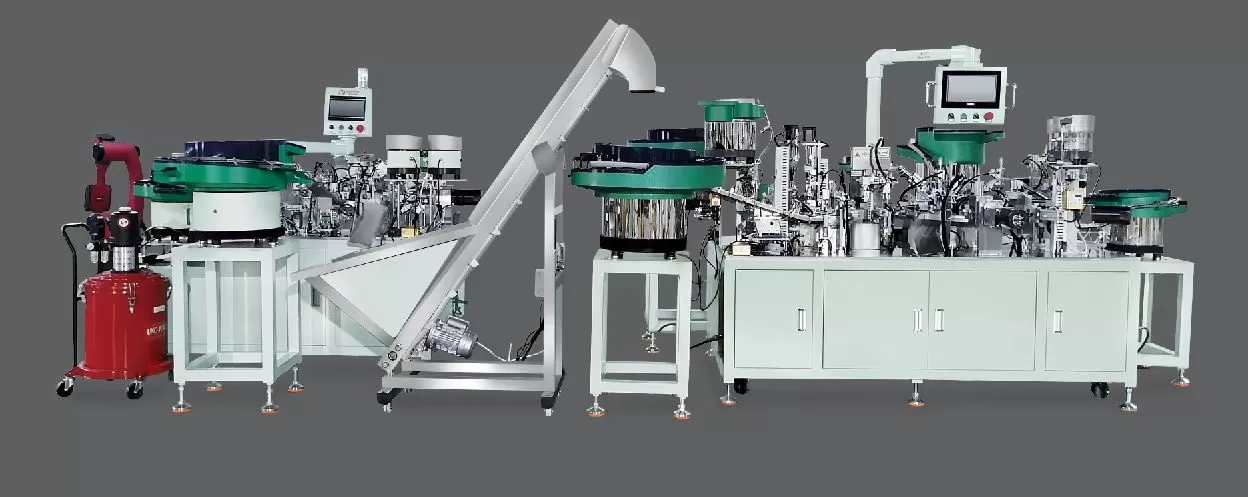
Video Demonstration of Jieyang Hinge Automatic Assembly Machine Operation Process

2025-12-25


A Video Demonstration of Jieyang Hinge Automatic Assembly Machine Operation Process serves as an essential resource for manufacturers aiming to optimize hinge production efficiency. As a professional supplier of assembly equipment, Sanyhore, based in Jieyang, has developed this advanced machine to streamline hinge manufacturing, reducing manual labor and ensuring consistent product quality. This article provides a comprehensive overview of its operation process, guiding users through each critical step.

Pre-Operation Preparation

Before starting the machine, thorough preparation is crucial to ensure smooth and safe operation. First, confirm the power supply is stable and meets the specified voltage requirements, typically 220V or 380V depending on the model. Next, check the air pressure in the pneumatic system, which should be maintained at 0.5-0.7MPa to power the machine’s cylinders and actuators. Inspect the material storage areas to ensure all necessary components—hinge bases, pins, rivets, and other small parts—are adequately stocked and properly loaded into the feeding systems. Additionally, verify that emergency stop buttons, safety guards, and sensors are in place and functioning correctly to prevent accidents during operation.

Machine Startup and Initialization

Once pre-operation checks are complete, initiate the machine startup process. Turn on the main power switch, followed by the control panel power. The machine’s PLC system will then undergo a self-diagnostic routine, which includes checking for errors in sensors, motors, and hydraulic/pneumatic components. During this phase, indicators on the control panel will light up to show the machine’s status—green for normal operation, yellow for warnings, and red for faults. If any error codes appear, refer to the user manual to troubleshoot before proceeding. After a successful self-test, set the production parameters, such as assembly speed and cycle time, based on the specific hinge model being processed.

Component Feeding and Positioning

The automatic assembly machine relies on advanced feeding systems to deliver components accurately. Hinge bases and pins are typically fed via vibration bowls, which use orbital motion to separate and orient parts before transporting them to the main assembly line. The bowls are calibrated to ensure each component is aligned correctly, preventing jams or misplacements. Once parts reach the assembly station, a robotic arm or mechanical gripper picks up the hinge base and positions it on the worktable. Concurrently, the pin or rivet is fed into a secondary positioning mechanism, which aligns it with the pre-drilled hole in the hinge base. This precise positioning ensures the subsequent assembly step is error-free.

Assembly Execution

The core of the machine’s operation lies in its assembly execution phase. Using a combination of mechanical pressure and precision tools, the machine performs tasks such as pin insertion, riveting, or welding, depending on the hinge type. For example, in a common pin hinge assembly, the machine first inserts the pin into the aligned hole using a hydraulic cylinder, applying controlled force to avoid damaging the component. If the hinge requires a riveted joint, the machine uses a riveting die to deform the rivet, securing the parts together with consistent strength. Throughout this process, vision sensors may monitor the assembly to ensure the pin depth is correct or the rivet is fully seated, with real-time feedback sent to the control system to adjust parameters if needed.

Quality Inspection and Product Discharge

After assembly, each hinge undergoes a quick quality inspection to meet industry standards. The machine’s integrated sensors check for key indicators, including pin tightness, joint alignment, and surface finish. If a defect is detected—such as a misaligned pin or a weak rivet—the system triggers a reject mechanism, diverting the faulty hinge to a separate bin. Concurrently, qualified hinges are moved to the discharge conveyor, which transports them to packaging or further processing. This automated inspection ensures only high-quality products proceed to the next stage, reducing manual sorting efforts and minimizing waste.

Shutdown and Post-Operation Maintenance

At the end of the production run, proper shutdown and maintenance are essential to extend the machine’s lifespan and ensure optimal performance. First, reduce the production speed to zero and stop the feeding systems. Then, power down the machine by turning off the control panel and main power switches. After the machine has cooled, perform routine maintenance tasks, such as cleaning the feeding bowls, lubricating moving parts with appropriate oil, and inspecting belts and hoses for wear. It is also advisable to document any issues encountered during operation in the machine’s maintenance log, which helps in identifying potential problems early and scheduling timely repairs.

Sanyhore, a leading manufacturer of hinge assembly machines, telescopic drawer slide assembly machines, and roll forming machines, is committed to providing reliable and efficient solutions for the manufacturing industry. By following the outlined operation process, users can maximize productivity while maintaining consistent quality. For inquiries about the Jieyang Hinge Automatic Assembly Machine or other assembly equipment, contact Sanyhore at +86 13425506550 or via email at info@sanyhore.com to discuss your specific production needs.

We use cookie to improve your online experience. By continuing to browse this website, you agree to our use of cookie.

Cookies

Please read our Terms and Conditions and this Policy before accessing or using our Services. If you cannot agree with this Policy or the Terms and Conditions, please do not access or use our Services. If you are located in a jurisdiction outside the European Economic Area, by using our Services, you accept the Terms and Conditions and accept our privacy practices described in this Policy.
We may modify this Policy at any time, without prior notice, and changes may apply to any Personal Information we already hold about you, as well as any new Personal Information collected after the Policy is modified. If we make changes, we will notify you by revising the date at the top of this Policy. We will provide you with advanced notice if we make any material changes to how we collect, use or disclose your Personal Information that impact your rights under this Policy. If you are located in a jurisdiction other than the European Economic Area, the United Kingdom or Switzerland (collectively “European Countries”), your continued access or use of our Services after receiving the notice of changes, constitutes your acknowledgement that you accept the updated Policy. In addition, we may provide you with real time disclosures or additional information about the Personal Information handling practices of specific parts of our Services. Such notices may supplement this Policy or provide you with additional choices about how we process your Personal Information.


Cookies

Cookies are small text files stored on your device when you access most Websites on the internet or open certain emails. Among other things, Cookies allow a Website to recognize your device and remember if you've been to the Website before. Examples of information collected by Cookies include your browser type and the address of the Website from which you arrived at our Website as well as IP address and clickstream behavior (that is the pages you view and the links you click).We use the term cookie to refer to Cookies and technologies that perform a similar function to Cookies (e.g., tags, pixels, web beacons, etc.). Cookies can be read by the originating Website on each subsequent visit and by any other Website that recognizes the cookie. The Website uses Cookies in order to make the Website easier to use, to support a better user experience, including the provision of information and functionality to you, as well as to provide us with information about how the Website is used so that we can make sure it is as up to date, relevant, and error free as we can. Cookies on the Website We use Cookies to personalize your experience when you visit the Site, uniquely identify your computer for security purposes, and enable us and our third-party service providers to serve ads on our behalf across the internet.

We classify Cookies in the following categories:
 ●  Strictly Necessary Cookies
 ●  Performance Cookies
 ●  Functional Cookies
 ●  Targeting Cookies


Cookie List
A cookie is a small piece of data (text file) that a website – when visited by a user – asks your browser to store on your device in order to remember information about you, such as your language preference or login information. Those cookies are set by us and called first-party cookies. We also use third-party cookies – which are cookies from a domain different than the domain of the website you are visiting – for our advertising and marketing efforts. More specifically, we use cookies and other tracking technologies for the following purposes:

Strictly Necessary Cookies
These cookies are necessary for the website to function and cannot be switched off in our systems. They are usually only set in response to actions made by you which amount to a request for services, such as setting your privacy preferences, logging in or filling in forms. You can set your browser to block or alert you about these cookies, but some parts of the site will not then work. These cookies do not store any personally identifiable information.

Functional Cookies
These cookies enable the website to provide enhanced functionality and personalisation. They may be set by us or by third party providers whose services we have added to our pages. If you do not allow these cookies then some or all of these services may not function properly.

Performance Cookies
These cookies allow us to count visits and traffic sources so we can measure and improve the performance of our site. They help us to know which pages are the most and least popular and see how visitors move around the site. All information these cookies collect is aggregated and therefore anonymous. If you do not allow these cookies we will not know when you have visited our site, and will not be able to monitor its performance.

Targeting Cookies
These cookies may be set through our site by our advertising partners. They may be used by those companies to build a profile of your interests and show you relevant adverts on other sites. They do not store directly personal information, but are based on uniquely identifying your browser and internet device. If you do not allow these cookies, you will experience less targeted advertising.

How To Turn Off Cookies
You can choose to restrict or block Cookies through your browser settings at any time. Please note that certain Cookies may be set as soon as you visit the Website, but you can remove them using your browser settings. However, please be aware that restricting or blocking Cookies set on the Website may impact the functionality or performance of the Website or prevent you from using certain services provided through the Website. It will also affect our ability to update the Website to cater for user preferences and improve performance. Cookies within Mobile Applications

We only use Strictly Necessary Cookies on our mobile applications. These Cookies are critical to the functionality of our applications, so if you block or delete these Cookies you may not be able to use the application. These Cookies are not shared with any other application on your mobile device. We never use the Cookies from the mobile application to store personal information about you.

If you have questions or concerns regarding any information in this Privacy Policy, please contact us by email at . You can also contact us via our customer service at our Site.