

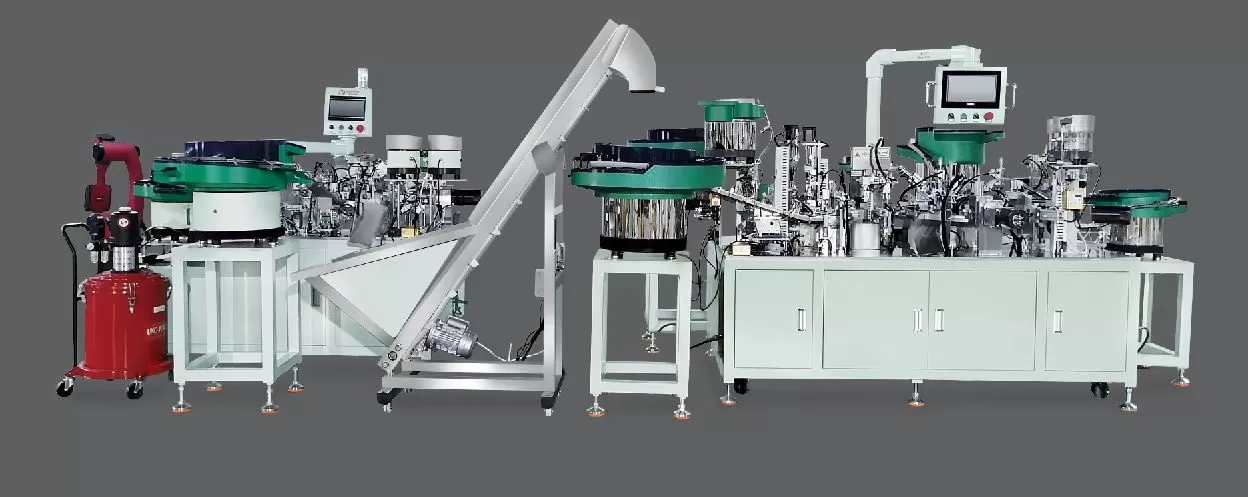
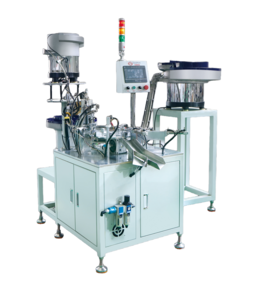
In the fast-paced world of furniture, automotive, and cabinetry manufacturing, the demand for precision, speed, and reliability in component assembly has never been higher. Hinges, a critical yet often overlooked part, require seamless integration of materials, mechanics, and technology to ensure durability and functionality. Enter Sanyhore’s 3D hinge assembly machine—a marvel of modern engineering that combines advanced scientific principles with practical manufacturing needs. This article delves into the science behind its efficiency, exploring how Sanyhore has redefined hinge production through innovative design and integrated technology.
#Mechanical Design: The Foundation of 3D Precision
At the core of Sanyhore’s machine lies a meticulously engineered mechanical structure. Unlike conventional 2D assembly systems, the 3D design leverages a multi-axis coordinate system, integrating linear guides, precision reducers, and high-torque servomotors. This setup allows the machine to position hinge components in three dimensions with sub-millimeter accuracy, eliminating misalignment issues that plague traditional assembly. The frame itself is constructed using high-strength cast iron, dampening vibrations during operation to maintain stability—critical for the consistent placement of small, delicate parts like spring clips and pivot pins. By minimizing mechanical play and maximizing rigidity, the design ensures each hinge meets strict dimensional tolerances, directly reducing post-assembly rework and scrap rates.
#Motion Control & Kinematics: Ensuring Seamless Component Alignment
Precision in assembly relies heavily on motion control, and Sanyhore’s machine employs state-of-the-art kinematic systems to achieve this. The system uses closed-loop servo drives paired with encoders and linear scales, enabling real-time adjustment of movement parameters. A sophisticated PID (Proportional-Integral-Derivative) control algorithm continuously monitors position feedback, correcting for minor deviations in real time. For example, when inserting a hinge pin, the machine’s Z-axis motor adjusts its speed and force based on sensor data, ensuring the pin seats perfectly without damaging the hinge’s surface. This dynamic control not only enhances assembly accuracy but also reduces cycle times, with each hinge now taking under 10 seconds to complete—marking a 40% improvement over manual or semi-automated methods.
#Material Science Integration: Balancing Strength and Flexibility
Hinges are subject to constant stress, requiring a balance between structural strength and flexibility. Sanyhore’s machine incorporates material science insights into its workflow, starting with optimized material handling. The system uses vibration feeders and orientation fixtures to separate and position hinges made from high-carbon steel or brass, ensuring consistent material properties. Additionally, the assembly process includes pre-tensioning and stress-relief steps, such as controlled compression of coil springs during installation. By integrating material-specific parameters into the machine’s software—like yield strength limits and thermal expansion coefficients—the system ensures hinges meet the exact performance requirements of end-users, whether for heavy-duty industrial applications or lightweight consumer goods.
#Automated Quality Assurance: Real-Time Monitoring & Feedback
A key differentiator of Sanyhore’s machine is its embedded quality control system, which combines industrial vision and force-sensing technologies. A high-resolution camera system inspects each hinge for visual defects—such as bent wires, misaligned holes, or uneven plating—with a 99.8% accuracy rate. Meanwhile, force sensors in the assembly heads measure the torque required to close the hinge, ensuring consistent spring tension and preventing under or over-tightening. Defective parts are immediately rejected and flagged for review, reducing the need for post-production inspections. This real-time feedback loop not only raises product quality but also provides manufacturers with actionable data on machine performance, allowing proactive maintenance and process adjustments.
#User-Centric Engineering: Optimizing for Production Efficiency
Beyond technical precision, Sanyhore prioritized user experience in the machine’s design. The interface features a 10-inch touchscreen with intuitive navigation, allowing operators to adjust parameters, monitor production metrics, and troubleshoot issues with minimal training. The machine also includes quick-change tooling systems, enabling the assembly of different hinge types in under 5 minutes—a critical feature for manufacturers producing diverse product lines. Furthermore, built-in data logging captures production rates, component usage, and maintenance intervals, helping plants optimize resource allocation. These user-centric elements don’t just simplify operation; they turn the machine into a strategic asset that adapts to evolving production demands.
#Conclusion: Sanyhore’s Commitment to Advancing Manufacturing Science
Sanyhore’s 3D Hinge Assembly Machine is more than a piece of equipment—it’s a testament to how combining scientific principles with engineering innovation can transform manufacturing. By integrating mechanical design, motion control, material science, and automated quality checks, the machine delivers efficiency, precision, and reliability that sets new industry standards. For manufacturers seeking to enhance production output while maintaining quality, Sanyhore offers a solution that extends beyond hinge assembly: the company also specializes in telescopic drawer slide assembly machines and roll forming equipment, providing comprehensive systems for modern cabinetry and furniture production.
To learn more about how Sanyhore’s technology can elevate your manufacturing process, contact our sales team at +86 13425506550 or email info@sanyhore.com. Let’s build the future of efficient, high-quality manufacturing together.


