
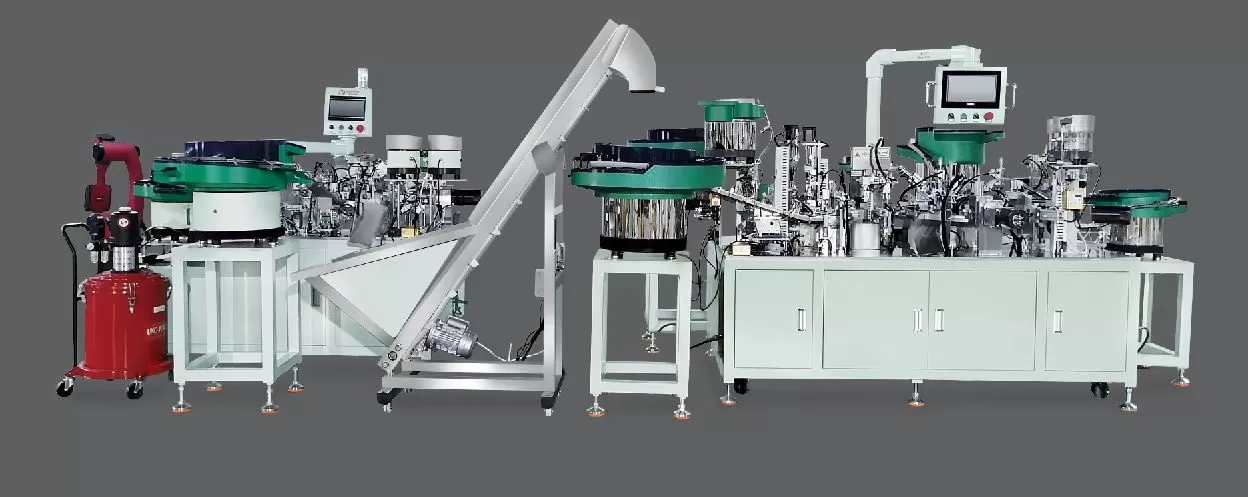
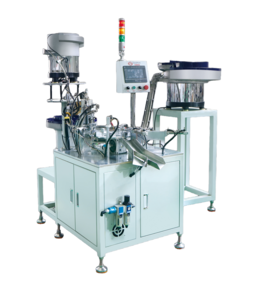
Precision Testing Process for Jieyang Hinge Automatic Assembly Machine

2025-12-25


In the manufacturing sector, the reliability of automatic assembly machines directly impacts product quality, especially for components like hinges used in furniture, automotive, and electronics. The Jieyang hinge automatic assembly machine, a critical piece of equipment, requires a meticulous precision testing process to ensure it meets strict industry standards. This process, which spans multiple stages, validates everything from dimensional accuracy to operational stability, laying the foundation for consistent, high-performance production.

1. Pre-Test Preparation: Establishing a Controlled Environment

Before initiating testing, a controlled environment is essential to eliminate external variables. Temperature, humidity, and ambient vibration are regulated to ±0.5°C, ±5% RH, and <0.1mm/s, respectively, as these factors can significantly affect measurement precision. Calibration of testing equipment—including coordinate measuring machines (CMMs), load cells, and vision systems—is conducted daily using certified reference standards. Additionally, the assembly machine itself undergoes a pre-test check: all mechanical components are inspected for tightness, and the control system is verified for software integrity to ensure no pre-existing faults influence test results.

2. Dimensional Accuracy Testing: Ensuring Component Alignment

The first critical test is dimensional accuracy measurement, which validates that all parts of the hinge assembly meet design specifications. Using a CMM with a 0.5μm probing accuracy, key dimensions such as hinge pin diameter, leaf thickness, and gap between mating surfaces are measured at 20+ points across each unit. The data is compared to a 3D CAD model, with a tolerance range of ±0.02mm permitted for most dimensions. For critical structural parts, a vision inspection system checks for parallelism and perpendicularity, ensuring that the machine’s output aligns with the precision required for subsequent assembly steps.

3. Functional Performance Testing: Verifying Operational Reliability

Beyond dimensions, functional performance is tested to confirm the machine’s ability to execute hinge assembly tasks accurately. A servo-controlled test rig simulates the assembly process: it drives the hinge pin insertion with controlled force (ranging from 50N to 500N, depending on hinge type) and measures insertion depth with a resolution of 0.01mm. During testing, the machine’s sensors monitor torque during pin press-fit, ensuring it stays within the optimal range to prevent damage to either the hinge or the machine. The system also records cycle times, with a target of <2 seconds per hinge assembly to meet production efficiency requirements.

4. Durability and Fatigue Testing: Simulating Long-Term Usage

To ensure the assembly machine can withstand extended production runs, a fatigue test is performed. The machine is operated continuously for 20,000 cycles, with each cycle simulating a complete hinge assembly operation. During testing, real-time data is collected on key metrics: positional accuracy drift (monitored via linear encoders), component wear (via vibration analysis), and control system stability. Post-test inspection reveals any permanent deformation in mechanical parts, and the control software is analyzed for drift in parameters. A pass criterion is set at <0.05mm positional error after 20,000 cycles, ensuring the machine maintains performance over time.

5. Compatibility and Interference Testing: Ensuring Seamless Integration

In multi-station production lines, the Jieyang hinge automatic assembly machine must work with upstream and downstream equipment without interference. Compatibility testing involves simulating interactions with a typical conveyor system and a vision inspection station. The machine’s interface protocols are verified for data exchange (e.g., part ID signals, start/stop commands), and mechanical clearances between components are checked to prevent jamming. A load test on the machine’s mounting structure ensures it can withstand the combined weight of connected equipment, confirming structural integrity during operation.

6. Post-Test Validation and Documentation

After completing all tests, data from each stage is compiled into a test report, which includes pass/fail results, measurement graphs, and a summary of deviations from standards.不合格 units are flagged for rework, with the root cause of issues analyzed to improve machine quality. Final validation involves a review by quality engineers, who confirm that all tests meet or exceed the established criteria before the machine is certified for production. This rigorous documentation not only ensures traceability but also provides customers with confidence in the machine’s reliability.

Sanyhore, a professional manufacturer specializing in hinge assembly machines, telescopic drawer slide assembly machines, and roll forming machines, is dedicated to delivering high-precision equipment through advanced testing processes. Our commitment to quality ensures that each automatic assembly machine, including the Jieyang hinge model, undergoes the same meticulous validation to meet diverse industrial needs. For inquiries about our testing methodologies or to discuss custom production solutions, please contact our sales manager at +86 13425506550 or send an email to info@sanyhore.com.

We use cookie to improve your online experience. By continuing to browse this website, you agree to our use of cookie.

Cookies

Please read our Terms and Conditions and this Policy before accessing or using our Services. If you cannot agree with this Policy or the Terms and Conditions, please do not access or use our Services. If you are located in a jurisdiction outside the European Economic Area, by using our Services, you accept the Terms and Conditions and accept our privacy practices described in this Policy.
We may modify this Policy at any time, without prior notice, and changes may apply to any Personal Information we already hold about you, as well as any new Personal Information collected after the Policy is modified. If we make changes, we will notify you by revising the date at the top of this Policy. We will provide you with advanced notice if we make any material changes to how we collect, use or disclose your Personal Information that impact your rights under this Policy. If you are located in a jurisdiction other than the European Economic Area, the United Kingdom or Switzerland (collectively “European Countries”), your continued access or use of our Services after receiving the notice of changes, constitutes your acknowledgement that you accept the updated Policy. In addition, we may provide you with real time disclosures or additional information about the Personal Information handling practices of specific parts of our Services. Such notices may supplement this Policy or provide you with additional choices about how we process your Personal Information.


Cookies

Cookies are small text files stored on your device when you access most Websites on the internet or open certain emails. Among other things, Cookies allow a Website to recognize your device and remember if you've been to the Website before. Examples of information collected by Cookies include your browser type and the address of the Website from which you arrived at our Website as well as IP address and clickstream behavior (that is the pages you view and the links you click).We use the term cookie to refer to Cookies and technologies that perform a similar function to Cookies (e.g., tags, pixels, web beacons, etc.). Cookies can be read by the originating Website on each subsequent visit and by any other Website that recognizes the cookie. The Website uses Cookies in order to make the Website easier to use, to support a better user experience, including the provision of information and functionality to you, as well as to provide us with information about how the Website is used so that we can make sure it is as up to date, relevant, and error free as we can. Cookies on the Website We use Cookies to personalize your experience when you visit the Site, uniquely identify your computer for security purposes, and enable us and our third-party service providers to serve ads on our behalf across the internet.

We classify Cookies in the following categories:
 ●  Strictly Necessary Cookies
 ●  Performance Cookies
 ●  Functional Cookies
 ●  Targeting Cookies


Cookie List
A cookie is a small piece of data (text file) that a website – when visited by a user – asks your browser to store on your device in order to remember information about you, such as your language preference or login information. Those cookies are set by us and called first-party cookies. We also use third-party cookies – which are cookies from a domain different than the domain of the website you are visiting – for our advertising and marketing efforts. More specifically, we use cookies and other tracking technologies for the following purposes:

Strictly Necessary Cookies
These cookies are necessary for the website to function and cannot be switched off in our systems. They are usually only set in response to actions made by you which amount to a request for services, such as setting your privacy preferences, logging in or filling in forms. You can set your browser to block or alert you about these cookies, but some parts of the site will not then work. These cookies do not store any personally identifiable information.

Functional Cookies
These cookies enable the website to provide enhanced functionality and personalisation. They may be set by us or by third party providers whose services we have added to our pages. If you do not allow these cookies then some or all of these services may not function properly.

Performance Cookies
These cookies allow us to count visits and traffic sources so we can measure and improve the performance of our site. They help us to know which pages are the most and least popular and see how visitors move around the site. All information these cookies collect is aggregated and therefore anonymous. If you do not allow these cookies we will not know when you have visited our site, and will not be able to monitor its performance.

Targeting Cookies
These cookies may be set through our site by our advertising partners. They may be used by those companies to build a profile of your interests and show you relevant adverts on other sites. They do not store directly personal information, but are based on uniquely identifying your browser and internet device. If you do not allow these cookies, you will experience less targeted advertising.

How To Turn Off Cookies
You can choose to restrict or block Cookies through your browser settings at any time. Please note that certain Cookies may be set as soon as you visit the Website, but you can remove them using your browser settings. However, please be aware that restricting or blocking Cookies set on the Website may impact the functionality or performance of the Website or prevent you from using certain services provided through the Website. It will also affect our ability to update the Website to cater for user preferences and improve performance. Cookies within Mobile Applications

We only use Strictly Necessary Cookies on our mobile applications. These Cookies are critical to the functionality of our applications, so if you block or delete these Cookies you may not be able to use the application. These Cookies are not shared with any other application on your mobile device. We never use the Cookies from the mobile application to store personal information about you.

If you have questions or concerns regarding any information in this Privacy Policy, please contact us by email at . You can also contact us via our customer service at our Site.