

.jpg)
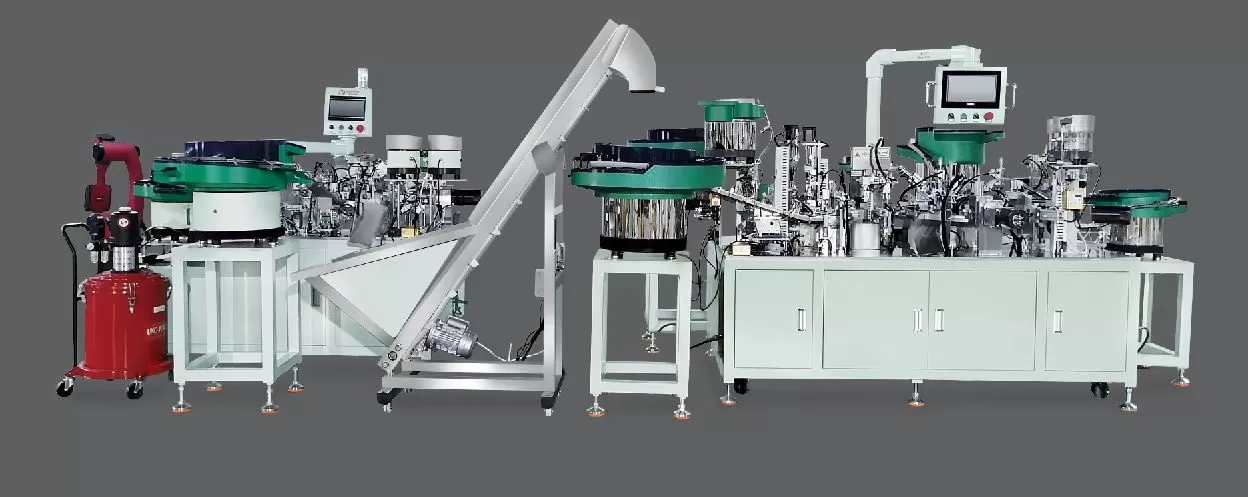
Drawer slides are the unsung heroes of modern furniture, cabinets, and storage systems, enabling smooth, reliable movement while supporting heavy loads. The quality of a slide directly impacts user experience, product durability, and operational efficiency. Behind this seamless functionality lies the science of precise assembly, a discipline where mechanical engineering, automation, and materials science converge. In Jieyang, a hub for precision manufacturing, drawer slide assembly machines embody this synergy, redefining how telescopic, ball-bearing, and side-mount slides are produced.
#The Mechanical Foundation: Structural Integrity and Motion Control
At the core of any drawer slide assembly machine is a robust mechanical design engineered to eliminate variables. Unlike manual assembly—where human error and fatigue dominate—automated systems rely on rigid frames, high-precision linear guides, and servo-driven mechanisms. For example, telescopic drawer slide assembly demands the seamless integration of inner and outer rails, often with hundreds of components like ball bearings, detents, and clips. The machine’s frame, typically crafted from cast iron or aluminum alloys, ensures minimal vibration during operation, a critical factor for maintaining the 0.01–0.03mm positional accuracy required for slide alignment.
Linear motion systems, such as ball screws and linear bearings, convert rotational motion from servo motors into precise linear movement, ensuring each component is positioned within tolerances. This mechanical foundation is non-negotiable: misalignment of even a single part can lead to jamming, uneven sliding, or premature wear, reducing the slide’s lifespan from years to months.
#Automation and Control: The Brain Behind Precision
Beyond mechanics, the "intelligence" of a drawer slide assembly machine lies in its control system. Modern machines leverage Programmable Logic Controllers (PLCs) and industrial PCs to coordinate every step of the assembly process. Sensors—including optical encoders, pressure transducers, and vision systems—constantly monitor component placement, force application, and material deformation, feeding real-time data back to the control unit.
For instance, when attaching ball bearings to the slide’s inner rail, the machine’s force-sensing system ensures the bearing is pressed into place with exactly 15N of force, preventing damage to the rail or misalignment of the bearing’s axis. Vision systems, using high-resolution cameras and AI-driven image recognition, verify the orientation of small components like detents, ensuring they engage with the rail’s slots correctly. This level of automation not only boosts production speed—often reaching 60+ slides per minute—but also reduces scrap rates by up to 30% compared to manual methods.
#Material Handling: Consistency in Component Integration
Drawer slide assembly machines also excel in material handling, a critical step often overlooked in precision manufacturing. The system must consistently feed components—ranging from thin metal rails to plastic end caps—without causing deformation or damage. Pneumatic grippers, designed with soft, non-marking pads, gently but firmly hold components during transfer, while vibration bowls and linear feeders sort and orient parts based on size and orientation.
For example, a roll forming machine, a key component in slide production, preforms the rail’s shape from sheet metal, ensuring uniform thickness and curvature. When integrated with the assembly machine, this pre-formed material requires minimal adjustment, reducing the risk of errors during the final assembly phase. By standardizing material handling, the machine ensures that even slides produced in different batches meet the same tight tolerances, a hallmark of reliable, long-lasting products.
#Quality Assurance: Inline Testing for Reliability
Precision assembly machines are not just about speed—they’re about ensuring every slide meets strict performance standards. Inline testing systems, often integrated directly into the production line, validate critical slide functions:
- Smoothness Test: A servo-driven tester applies a controlled load to the slide, measuring the force required to extend and retract it. Slides must meet minimum and maximum force thresholds to ensure they’re neither too stiff (difficult to use) nor too loose (prone to jamming).
- Load-Bearing Test: Under computer control, the machine simulates real-world usage by applying a downward load to the slide while it’s extended, checking for deformation or failure after repeated cycles (e.g., 10,000+ operations).
- Dimensional Check: Laser scanners verify the alignment of the slide’s rails and the spacing between components, ensuring they fit seamlessly into furniture frames or drawer units.
These tests are non-intrusive, conducted in milliseconds, and only reject slides that fail to meet standards, preventing defective products from reaching the market.
#Industry Impact: From Production Lines to Consumer Trust
The science of precise drawer slide assembly isn’t just about manufacturing efficiency—it’s about building trust. For manufacturers, these machines reduce labor costs by 70% and increase output by 2–3x, allowing them to meet growing demand without compromising quality. For consumers, the result is a product that glides smoothly for years, reducing the need for repairs and replacements.
As a professional manufacturer of hinge assembly machines, roll forming machines, and telescopic drawer slide assembly systems, we understand the challenges of scaling production while maintaining precision. Our machines, designed with a focus on durability and adaptability, can be customized to handle different slide types, from light-duty kitchen slides to heavy-duty industrial drawer systems.
For inquiries about optimizing your production line, contact our sales manager at +86 13425506550 or email info@sanyhore.com. Let’s discuss how our expertise in precise assembly can elevate your product quality and production efficiency.
相关问题与回复(SEO常见问题):
Q: How does a drawer slide assembly machine ensure the precision of telescopic slides?
A: Our machines use servo-control systems with ±0.02mm positional accuracy, paired with vision sensors and force transducers to monitor component placement and engagement. This ensures telescopic slides meet strict performance standards for smooth operation and load capacity.
Q: What makes Sanyhore’s hinge assembly machines suitable for high-volume production?
A: We integrate robust mechanical design with intelligent automation, reducing manual intervention and minimizing setup time. Our hinge assembly machines operate at speeds up to 80 hinges per minute, with inline testing to ensure 100% quality control, making them ideal for large-scale manufacturing.


