Jieyang Drawer Slide Assembly Machine: Automatic vs Semi-Automatic Options

2025-12-16


In the furniture manufacturing sector, drawer slide systems are vital for product durability and user satisfaction. As a key production hub for hardware components, Jieyang has become a leading source of drawer slide assembly machines, offering both automatic and semi-automatic options to meet varied industrial needs. This analysis delves into the key differences between these two types, helping manufacturers select the most suitable equipment for their operations.

How Automatic and Semi-Automatic Slide Assembly Machines Operate

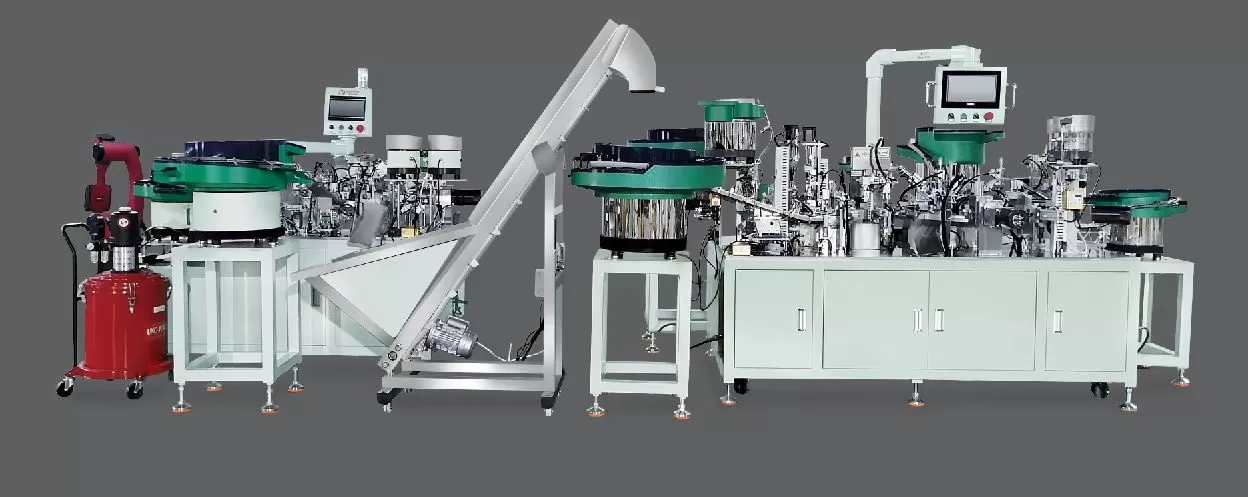
Automatic drawer slide assembly machines leverage advanced automation technologies, including programmable logic controllers (PLCs), servo motors, and robotic arms. These systems can independently handle the entire assembly process: from material feeding (raw rails, balls, and fasteners) to precise component alignment, riveting, and final quality checks. A vision system often ensures accurate part placement, while a conveyor belt streamlines the flow of finished products.

Semi-automatic machines, by contrast, require partial human intervention. Operators manually load raw materials onto a worktable, position slide components (e.g., aligning rails with ball bearings), and initiate the assembly cycle. While the machine automates repetitive tasks like clamping and riveting, manual input remains necessary for loading and occasional adjustments.

Productivity and Efficiency Comparison

Efficiency is a primary distinction between the two types. Automatic machines dominate high-volume production, with typical speeds of 300–500 telescopic drawer slides per hour (depending on slide complexity). This speed is achieved through continuous, unattended operation, minimizing downtime and maximizing output.

Semi-automatic systems, designed for moderate production, operate at 100–200 slides per hour. While slower, they are ideal for manufacturers with lower daily output or frequent order changes, as they allow for quicker setup and adaptation to varying slide designs.

Cost Analysis: Initial Investment vs Long-Term Savings

Cost considerations are critical for decision-making. Automatic systems have higher upfront costs, ranging from $50,000 to $150,000, depending on features like integration with existing production lines or compatibility with custom slide sizes. However, this investment often pays off in the long run: reduced labor costs (eliminating the need for 2–3 operators per shift), lower error rates (fewer defective slides), and faster throughput, making them cost-effective for large-scale producers.

Semi-automatic machines, with initial costs of $10,000–$40,000, are more budget-friendly. They suit small-to-medium enterprises, custom furniture workshops, or startups with limited capital, offering a lower barrier to entry without sacrificing core functionality.

Application Scenarios: When to Choose Each Type

The choice between automatic and semi-automatic machines hinges on production needs. Automatic systems excel in large-scale settings, such as major furniture brands, bulk slide suppliers, or companies with monthly targets exceeding 100,000 slides. For example, a global furniture manufacturer might rely on an automatic machine to ensure consistent quality and meet tight delivery deadlines.

Semi-automatic machines are better for flexible, low-to-moderate production. A local workshop producing custom telescopic slides, or a small business catering to niche markets, would benefit from the adaptability of semi-automatic systems, which allow for quick changes in slide designs or batch sizes.

Key Features to Evaluate for Optimal Performance

Regardless of type, critical features include precision (to ensure slide components align correctly, preventing jams or poor sliding performance), compatibility (handling diverse slide sizes and materials like steel or aluminum), and ease of maintenance (quick access to parts for repairs, reducing downtime).

Sanyhore, a professional manufacturer of hinge assembly machines and drawer slide assembly equipment, designs machines with these factors in mind. Our equipment combines durability, flexibility, and user-friendly operation, making it suitable for both automatic and semi-automatic applications.

Ultimately, the right drawer slide assembly machine depends on your production scale, budget, and long-term goals. For high-volume, consistent output, an automatic system delivers efficiency. For smaller runs or flexible operations, a semi-automatic model offers cost-effectiveness. To learn how Sanyhore’s solutions can optimize your production, contact our team today at +86 13425506550 or email info@sanyhore.com. Our experts are ready to help you find the perfect fit.

We use cookie to improve your online experience. By continuing to browse this website, you agree to our use of cookie.

Cookies

Please read our Terms and Conditions and this Policy before accessing or using our Services. If you cannot agree with this Policy or the Terms and Conditions, please do not access or use our Services. If you are located in a jurisdiction outside the European Economic Area, by using our Services, you accept the Terms and Conditions and accept our privacy practices described in this Policy.
We may modify this Policy at any time, without prior notice, and changes may apply to any Personal Information we already hold about you, as well as any new Personal Information collected after the Policy is modified. If we make changes, we will notify you by revising the date at the top of this Policy. We will provide you with advanced notice if we make any material changes to how we collect, use or disclose your Personal Information that impact your rights under this Policy. If you are located in a jurisdiction other than the European Economic Area, the United Kingdom or Switzerland (collectively “European Countries”), your continued access or use of our Services after receiving the notice of changes, constitutes your acknowledgement that you accept the updated Policy. In addition, we may provide you with real time disclosures or additional information about the Personal Information handling practices of specific parts of our Services. Such notices may supplement this Policy or provide you with additional choices about how we process your Personal Information.


Cookies

Cookies are small text files stored on your device when you access most Websites on the internet or open certain emails. Among other things, Cookies allow a Website to recognize your device and remember if you've been to the Website before. Examples of information collected by Cookies include your browser type and the address of the Website from which you arrived at our Website as well as IP address and clickstream behavior (that is the pages you view and the links you click).We use the term cookie to refer to Cookies and technologies that perform a similar function to Cookies (e.g., tags, pixels, web beacons, etc.). Cookies can be read by the originating Website on each subsequent visit and by any other Website that recognizes the cookie. The Website uses Cookies in order to make the Website easier to use, to support a better user experience, including the provision of information and functionality to you, as well as to provide us with information about how the Website is used so that we can make sure it is as up to date, relevant, and error free as we can. Cookies on the Website We use Cookies to personalize your experience when you visit the Site, uniquely identify your computer for security purposes, and enable us and our third-party service providers to serve ads on our behalf across the internet.

We classify Cookies in the following categories:
 ●  Strictly Necessary Cookies
 ●  Performance Cookies
 ●  Functional Cookies
 ●  Targeting Cookies


Cookie List
A cookie is a small piece of data (text file) that a website – when visited by a user – asks your browser to store on your device in order to remember information about you, such as your language preference or login information. Those cookies are set by us and called first-party cookies. We also use third-party cookies – which are cookies from a domain different than the domain of the website you are visiting – for our advertising and marketing efforts. More specifically, we use cookies and other tracking technologies for the following purposes:

Strictly Necessary Cookies
These cookies are necessary for the website to function and cannot be switched off in our systems. They are usually only set in response to actions made by you which amount to a request for services, such as setting your privacy preferences, logging in or filling in forms. You can set your browser to block or alert you about these cookies, but some parts of the site will not then work. These cookies do not store any personally identifiable information.

Functional Cookies
These cookies enable the website to provide enhanced functionality and personalisation. They may be set by us or by third party providers whose services we have added to our pages. If you do not allow these cookies then some or all of these services may not function properly.

Performance Cookies
These cookies allow us to count visits and traffic sources so we can measure and improve the performance of our site. They help us to know which pages are the most and least popular and see how visitors move around the site. All information these cookies collect is aggregated and therefore anonymous. If you do not allow these cookies we will not know when you have visited our site, and will not be able to monitor its performance.

Targeting Cookies
These cookies may be set through our site by our advertising partners. They may be used by those companies to build a profile of your interests and show you relevant adverts on other sites. They do not store directly personal information, but are based on uniquely identifying your browser and internet device. If you do not allow these cookies, you will experience less targeted advertising.

How To Turn Off Cookies
You can choose to restrict or block Cookies through your browser settings at any time. Please note that certain Cookies may be set as soon as you visit the Website, but you can remove them using your browser settings. However, please be aware that restricting or blocking Cookies set on the Website may impact the functionality or performance of the Website or prevent you from using certain services provided through the Website. It will also affect our ability to update the Website to cater for user preferences and improve performance. Cookies within Mobile Applications

We only use Strictly Necessary Cookies on our mobile applications. These Cookies are critical to the functionality of our applications, so if you block or delete these Cookies you may not be able to use the application. These Cookies are not shared with any other application on your mobile device. We never use the Cookies from the mobile application to store personal information about you.

If you have questions or concerns regarding any information in this Privacy Policy, please contact us by email at . You can also contact us via our customer service at our Site.