

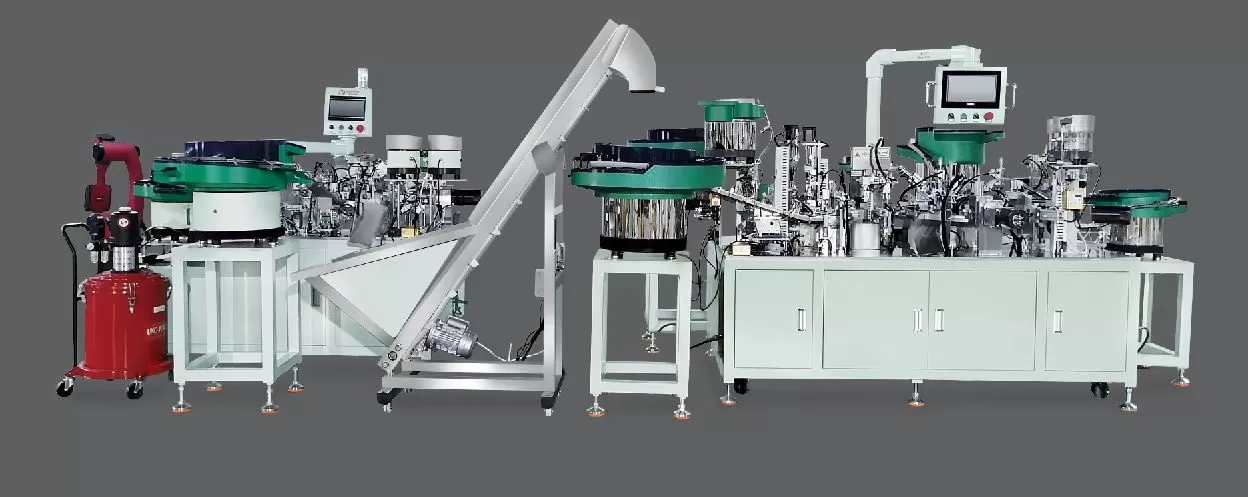
Hinge assembly operations demand careful capacity planning to balance efficiency, cost, and production goals. When investing in a fully automatic hinge assembler, selecting the right capacity is critical to avoid underperformance or over-investment. Sanyhore, a trusted manufacturer of industrial assembly machinery, offers advanced fully automatic hinge assemblers designed to adapt to diverse production needs. This guide explores key factors to consider when determining the optimal capacity for your specific hinge assembly process.
Understanding Capacity Requirements for Hinge Assembly
Before choosing a machine, define your production capacity needs clearly. Capacity here refers to the machine’s ability to complete hinge assembly tasks within a specific timeframe, typically measured in units per hour, day, or month. Start by analyzing your current and projected production volume. For example, a small workshop producing 5,000 hinges daily may need a lower-capacity model, while a large manufacturer scaling to 50,000 hinges per day would require a higher-capacity system. Additionally, consider product complexity: hinges with intricate designs or multiple components may demand slower processing, reducing effective capacity. Sanyhore’s fully automatic hinge assemblers are engineered to handle various production scales, from small batch to high-volume runs.
Key Factors Influencing Capacity Selection
Several variables impact the right capacity for your hinge assembly line. First, production scale: Align machine capacity with your daily, weekly, or monthly output goals. A machine with 1,000 hinges per hour capacity is unsuitable for a 5,000 hinges per hour requirement, as it would lead to bottlenecks. Conversely, an overly large machine for low-volume needs wastes energy and floor space.
Second, product specifications: Hinge size, weight, and precision requirements affect processing speed. Smaller, lightweight hinges may allow faster assembly cycles, while heavy or high-precision hinges (e.g., for automotive or furniture) need more stable, slower operations. Sanyhore’s equipment is designed with adjustable parameters to accommodate different hinge types, ensuring you can optimize capacity without sacrificing quality.
Third, integration with existing systems: Consider whether the assembler needs to integrate with upstream or downstream processes (e.g., feeding, sorting, or packaging). A standalone machine with lower capacity might suffice if it connects seamlessly to other equipment, while a high-capacity standalone model could overwhelm your current workflow. Sanyhore offers modular designs that adapt to diverse production line configurations.
Matching Production Scale with Machine Capacity
Your production scale dictates the minimum and maximum capacity needed. For startups or small businesses with limited space and resources, a mid-range capacity machine (e.g., 1,500–3,000 hinges per hour) balances flexibility and cost-effectiveness. These models are easy to operate, require less maintenance, and can scale gradually as demand grows.
Medium-sized enterprises with steady growth may benefit from high-capacity machines (3,000–6,000 hinges per hour) that handle consistent demand while leaving room for expansion. For large-scale manufacturers, ultra-high-capacity systems (6,000+ hinges per hour) with advanced automation (e.g., robotic feeding or vision inspection) ensure 24/7 production without downtime. Sanyhore’s fully automatic hinge assemblers are available in multiple capacity tiers, allowing you to match your current scale while planning for future growth.
Ensuring Quality While Scaling Production
Capacity selection isn’t just about speed—it must also guarantee product quality. A machine with excessive capacity might rush operations, leading to misalignment, loose parts, or inconsistent performance. Conversely, under-capacity machines may force operators to compromise on precision to meet output. Sanyhore’s equipment addresses this by integrating precision engineering: high-quality components, servo-driven systems, and real-time monitoring to maintain accuracy even at peak capacity. This ensures that as you scale up, your hinge quality remains consistent, reducing rework and customer complaints.
Long-Term Reliability and After-Sales Support
Choosing a machine with the right capacity also involves considering long-term reliability. Sanyhore prioritizes durability in its fully automatic hinge assemblers, using robust materials and proven mechanisms to minimize wear and tear. This reduces downtime and maintenance costs, making it easier to sustain your target capacity over time. Additionally, Sanyhore provides comprehensive after-sales support, including technical training, spare parts availability, and on-site assistance, ensuring you can address any issues promptly and keep your production running smoothly.
When selecting a Sanyhore fully automatic hinge assembler, prioritize clarity in your production goals, align capacity with your scale, and ensure the machine integrates seamlessly with your operations. With the right capacity, you can enhance efficiency, reduce costs, and position your business for growth. For personalized guidance on choosing the optimal model, contact our sales manager at +86 13425506550 or send an inquiry to info@sanyhore.com.


