
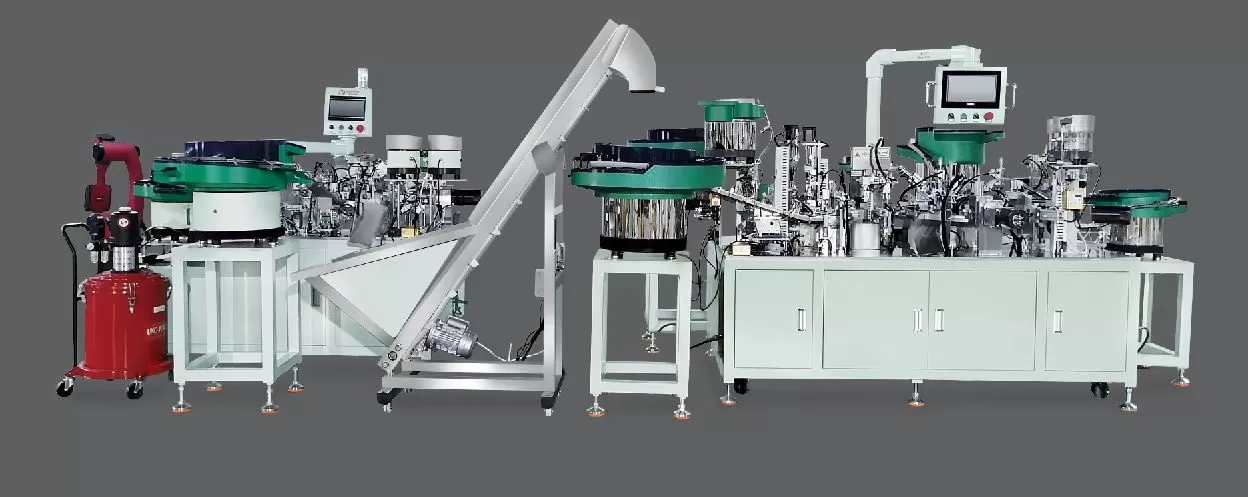
How to Calibrate Sanyhore Fully Automatic Hinge Assembly Machine for Precision

2025-12-04


Calibrating a Sanyhore fully automatic hinge assembly machine is critical for maintaining consistent assembly precision, which directly impacts product quality and operational efficiency. As a leading manufacturer specializing in hinge assembly machines, telescopic drawer slide assembly machines, and roll forming machines, Sanyhore understands the importance of precise calibration. This guide outlines the essential steps to ensure your Sanyhore hinge assembly machine operates at peak accuracy, helping you avoid defects and extend equipment lifespan.

Pre-Calibration Preparation

Before starting the calibration process, prioritize safety and readiness. First, power off the machine and lock the control panel to prevent accidental activation. Gather necessary tools: a digital caliper (0.01mm precision), torque wrench, feeler gauges, a level, and a synchronization tester (if available). Inspect the machine for debris, loose components, or oil leaks—clean and lubricate moving parts as needed. Verify the calibration certificate of the reference tools (e.g., calipers) to ensure they are within their valid calibration period. This preparation phase minimizes errors and ensures reliable results.

Key Calibration Parameters to Check

Sanyhore’s hinge assembly machine relies on several critical parameters for precision. Focus on these during calibration:

- Positioning Accuracy: The horizontal/vertical deviation of hinge placement relative to the target position.

- Pressure Parameters: The force exerted by clamping or pressing units to avoid damaging hinge components or causing misalignment.

- Synchronization: Coordination between the machine’s conveyor, grippers, and assembly tools to prevent jams or delays.

- Sensor Sensitivity: The responsiveness of optical or mechanical sensors that detect hinge presence and orientation.

- Mechanical Clearance: The gap between moving parts (e.g., slides, gears) to ensure smooth motion without backlash.

Step-by-Step Calibration Process

#1. System Initialization and Reference Setting

Power on the machine and allow the control system to boot fully. Navigate to the calibration menu in the HMI (Human-Machine Interface) and select "Reference Point Calibration." Follow prompts to set the machine’s origin (e.g., the home position of the main assembly arm). Use a level to adjust the machine base if it shows signs of tilting, ensuring all components rest on a flat, stable surface.

#2. Positioning Accuracy Adjustment

Place a test hinge blank on the machine’s worktable. Use a digital caliper to measure the distance from the blank’s edge to the target assembly position. Compare this with the machine’s display value. If there’s a deviation (e.g., ±0.03mm), access the "Positioning Adjustment" submenu in the HMI. Input the correction value, then use the machine’s adjustment knobs (for X/Y/Z axes) to fine-tune the position. Repeat the measurement until the deviation is within the acceptable range (typically ±0.02mm for most hinge types).

#3. Pressure and Force Calibration

Select the "Pressure Calibration" function. The machine will simulate clamping or pressing actions. Use a force gauge to measure the actual pressure exerted by the tooling. Adjust the pressure settings in the HMI to match the recommended values (e.g., 8-12 bar for mild steel hinges, 5-8 bar for brass hinges). Test with a sample hinge—if it deforms or fails to seat properly, adjust the pressure incrementally (0.5 bar steps) until the force is optimal.

#4. Synchronization Verification

Run the machine in "Test Mode" and observe the movement of key components: the conveyor belt, gripper arms, and main assembly unit. Use a stroboscope to check if all parts move in sync. If the gripper closes 0.2 seconds before the conveyor stops, access the "Synchronization Settings" menu and adjust the delay parameter. Repeat the test until the time difference between component movements is less than 0.1 seconds.

#5. Sensor and Clearance Calibration

Place a hinge with a known thickness (e.g., 1.2mm) under the sensor. If the HMI fails to detect it, adjust the sensor’s sensitivity via the "Sensor Calibration" submenu. For mechanical clearance, check the gap between the slide and guide rail using feeler gauges. If the gap exceeds 0.1mm, tighten the guide rail screws or replace worn components to eliminate backlash.

Post-Calibration Validation

After adjusting all parameters, run a 100-unit production test. Measure 5-10 samples randomly, checking critical dimensions like hinge height, gap between leaves, and alignment error. A合格的 (qualified) product should have:

- Height deviation: ±0.05mm

- Gap between leaves: 0.1-0.3mm

- No misalignment or burrs.

Record the calibration results and set a reminder for the next calibration (typically every 3 months or 10,000 units, depending on usage).

Why Choose Sanyhore for Hinge Assembly Machines?

Sanyhore is a trusted manufacturer of fully automatic hinge assembly machines, telescopic drawer slide assembly machines, and roll forming machines. Our machines combine advanced engineering with user-friendly calibration features, ensuring long-term precision and minimal downtime. For professional support, contact our team today: +86 13425506550 or email info@sanyhore.com. Let us help you maximize the performance of your Sanyhore equipment.

We use cookie to improve your online experience. By continuing to browse this website, you agree to our use of cookie.

Cookies

Please read our Terms and Conditions and this Policy before accessing or using our Services. If you cannot agree with this Policy or the Terms and Conditions, please do not access or use our Services. If you are located in a jurisdiction outside the European Economic Area, by using our Services, you accept the Terms and Conditions and accept our privacy practices described in this Policy.
We may modify this Policy at any time, without prior notice, and changes may apply to any Personal Information we already hold about you, as well as any new Personal Information collected after the Policy is modified. If we make changes, we will notify you by revising the date at the top of this Policy. We will provide you with advanced notice if we make any material changes to how we collect, use or disclose your Personal Information that impact your rights under this Policy. If you are located in a jurisdiction other than the European Economic Area, the United Kingdom or Switzerland (collectively “European Countries”), your continued access or use of our Services after receiving the notice of changes, constitutes your acknowledgement that you accept the updated Policy. In addition, we may provide you with real time disclosures or additional information about the Personal Information handling practices of specific parts of our Services. Such notices may supplement this Policy or provide you with additional choices about how we process your Personal Information.


Cookies

Cookies are small text files stored on your device when you access most Websites on the internet or open certain emails. Among other things, Cookies allow a Website to recognize your device and remember if you've been to the Website before. Examples of information collected by Cookies include your browser type and the address of the Website from which you arrived at our Website as well as IP address and clickstream behavior (that is the pages you view and the links you click).We use the term cookie to refer to Cookies and technologies that perform a similar function to Cookies (e.g., tags, pixels, web beacons, etc.). Cookies can be read by the originating Website on each subsequent visit and by any other Website that recognizes the cookie. The Website uses Cookies in order to make the Website easier to use, to support a better user experience, including the provision of information and functionality to you, as well as to provide us with information about how the Website is used so that we can make sure it is as up to date, relevant, and error free as we can. Cookies on the Website We use Cookies to personalize your experience when you visit the Site, uniquely identify your computer for security purposes, and enable us and our third-party service providers to serve ads on our behalf across the internet.

We classify Cookies in the following categories:
 ●  Strictly Necessary Cookies
 ●  Performance Cookies
 ●  Functional Cookies
 ●  Targeting Cookies


Cookie List
A cookie is a small piece of data (text file) that a website – when visited by a user – asks your browser to store on your device in order to remember information about you, such as your language preference or login information. Those cookies are set by us and called first-party cookies. We also use third-party cookies – which are cookies from a domain different than the domain of the website you are visiting – for our advertising and marketing efforts. More specifically, we use cookies and other tracking technologies for the following purposes:

Strictly Necessary Cookies
These cookies are necessary for the website to function and cannot be switched off in our systems. They are usually only set in response to actions made by you which amount to a request for services, such as setting your privacy preferences, logging in or filling in forms. You can set your browser to block or alert you about these cookies, but some parts of the site will not then work. These cookies do not store any personally identifiable information.

Functional Cookies
These cookies enable the website to provide enhanced functionality and personalisation. They may be set by us or by third party providers whose services we have added to our pages. If you do not allow these cookies then some or all of these services may not function properly.

Performance Cookies
These cookies allow us to count visits and traffic sources so we can measure and improve the performance of our site. They help us to know which pages are the most and least popular and see how visitors move around the site. All information these cookies collect is aggregated and therefore anonymous. If you do not allow these cookies we will not know when you have visited our site, and will not be able to monitor its performance.

Targeting Cookies
These cookies may be set through our site by our advertising partners. They may be used by those companies to build a profile of your interests and show you relevant adverts on other sites. They do not store directly personal information, but are based on uniquely identifying your browser and internet device. If you do not allow these cookies, you will experience less targeted advertising.

How To Turn Off Cookies
You can choose to restrict or block Cookies through your browser settings at any time. Please note that certain Cookies may be set as soon as you visit the Website, but you can remove them using your browser settings. However, please be aware that restricting or blocking Cookies set on the Website may impact the functionality or performance of the Website or prevent you from using certain services provided through the Website. It will also affect our ability to update the Website to cater for user preferences and improve performance. Cookies within Mobile Applications

We only use Strictly Necessary Cookies on our mobile applications. These Cookies are critical to the functionality of our applications, so if you block or delete these Cookies you may not be able to use the application. These Cookies are not shared with any other application on your mobile device. We never use the Cookies from the mobile application to store personal information about you.

If you have questions or concerns regarding any information in this Privacy Policy, please contact us by email at . You can also contact us via our customer service at our Site.