

.png)
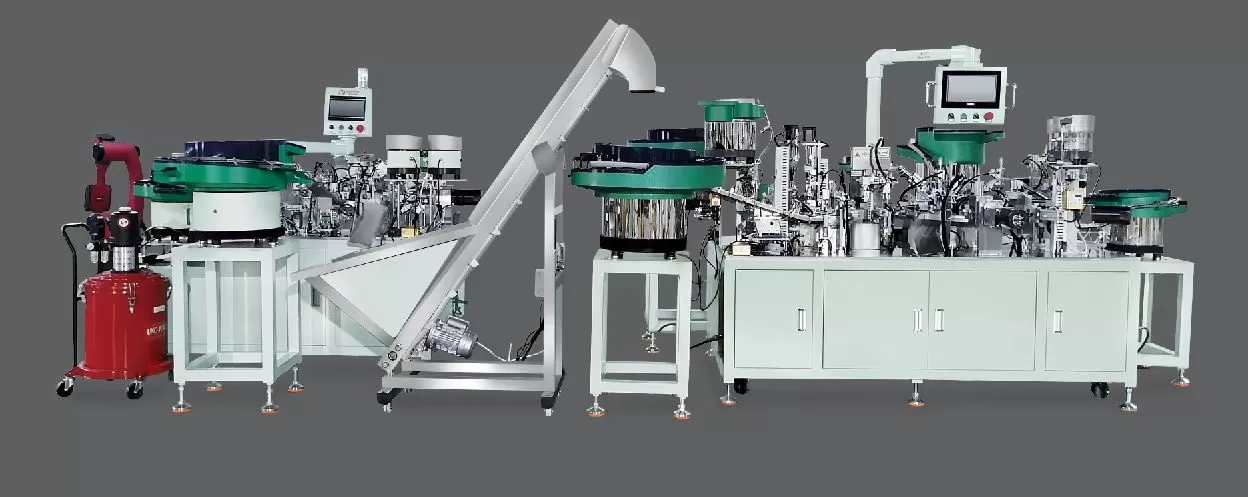
Adjusting settings on a Sanyhore fully automatic hinge assembly machine is a critical step to ensure consistent production quality, efficiency, and machine longevity. Whether you’re optimizing for new hinge types, addressing production issues, or maintaining peak performance, following a systematic approach will help you achieve precise results. Below is a step-by-step guide to adjusting key settings on your Sanyhore hinge assembly machine.
#1. Preparatory Work: Ensuring Safety and Readiness
Before any adjustments, prioritize safety to prevent equipment damage or personal injury. First, power off the machine and lock the control panel to avoid accidental startup. Gather necessary tools, including a wrench set, screwdriver, and a manual or digital caliper for measuring. Familiarize yourself with the machine’s user manual to identify components like the main control panel, parameter knobs, and adjustment levers. Confirm the hinge type and batch size to align settings with production requirements.
#2. Basic Parameter Adjustment: Laying the Foundation
Start with core parameters that govern the machine’s overall operation. The main control panel typically includes speed, pressure, and position settings. For speed, use the variable frequency drive (VFD) to adjust the conveyor and press unit speed. A general guideline is 15–30 cycles per minute for standard hinge types; slower speeds (10–15 cycles/min) may be needed for delicate or oversized hinges to prevent jams.
Next, adjust the press pressure. Use the pressure regulator valve to set the force applied during hinge pin insertion. Over-pressure can damage hinge materials or misalign components, while under-pressure may result in loose pin connections. Refer to the hinge material specifications (e.g., steel, brass) for pressure ranges—typically 3–8 bar for standard steel hinges.
Finally, calibrate the positioning基准 (reference position) using the machine’s manual adjustment knobs. Align the hinge cup and pin feeder with the assembly station to ensure the pin centers are within 0.1mm of the target position. Use a dial indicator to verify accuracy, making fine adjustments until the indicator shows minimal deviation.
#3. Functional Module Calibration: Precision for Critical Operations
Sanyhore hinge assembly machines often include specialized modules like the pin feeding mechanism, glue application unit, and quality inspection sensor. Each requires specific calibration.
For the pin feeding module: If pins are misaligned or jamming, adjust the track width and height. Loosen the guide rail screws, slide them to fit the pin diameter (e.g., 2.5mm pins need a 3mm track gap), and tighten the screws. Test feed speed by running a short batch and observe if pins align correctly with the assembly arm.
For glue application (if applicable): If glue is uneven or missing, adjust the glue valve’s opening time and pressure. Use a stopwatch to measure the glue flow duration—typically 0.3–0.5 seconds for a consistent bead. Ensure the glue nozzle is 1–2mm from the hinge joint to avoid excess glue overflow.
For the quality inspection sensor: Most Sanyhore machines integrate photoelectric or laser sensors to detect misassembled hinges. If the sensor fails to reject defective units, check the detection distance and sensitivity. Adjust the sensor’s position so it aligns with the hinge pin and cup interface, then test with a sample of misaligned hinges to confirm rejection accuracy.
#4. Trial Production and Optimization: Refining for Efficiency
After initial adjustments, run a trial production batch of 50–100 hinges. Monitor the assembly process for common issues like pin protrusion, misaligned cups, or uneven pressure marks. For each problem, revisit the relevant settings:
- If pin protrudes beyond the hinge, reduce the press depth by 0.1–0.2mm.
- If the hinge cup is misaligned, recheck the positioning基准 and adjust the clamping mechanism’s tightness.
- If pressure marks appear, decrease the press pressure by 1–2 bar.
Document the optimal settings for the current hinge type and batch size, then save these parameters in the machine’s memory to avoid reconfiguration for future runs.
#5. Daily Maintenance and Long-Term Settings Management
To ensure consistent performance, schedule regular maintenance and parameter checks. Clean the adjustment knobs and levers to prevent dust buildup, which can cause inaccurate adjustments. Inspect the conveyor belt and feeding tracks for wear, replacing worn parts promptly to avoid misalignment.
For long-term optimization, periodically review production data (e.g., cycle time, defect rate) and adjust settings as hinge materials or batch sizes change. Sanyhore’s hinge assembly machines are designed for adaptability, so leveraging the machine’s user-friendly interface to update parameters will keep production efficient.
As a professional manufacturer of hinge assembly machines, telescopic drawer slide assembly machines, and roll forming machines, Sanyhore is committed to supporting your production needs. If you encounter challenges during settings adjustment or require technical guidance, contact our team directly at +86 13425506550 or info@sanyhore.com. Our experts are available to help you maximize machine performance and drive your production success.


