

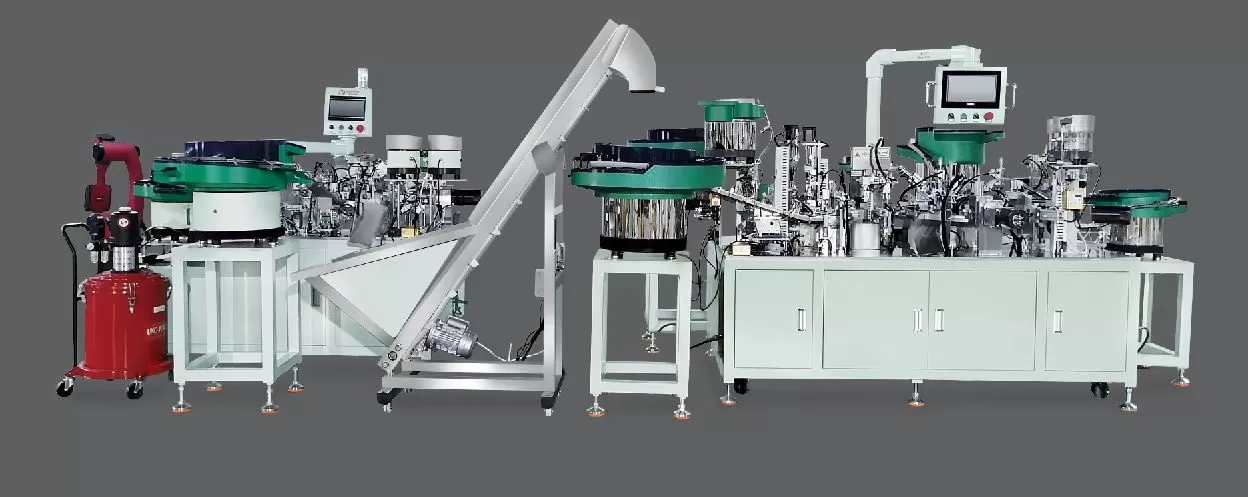
The global demand for soft-closing hardware—from kitchen drawer slides to cabinet hinges—has surged in recent years, driven by consumer expectations for smoother, quieter, and more durable home and commercial fixtures. This shift has not only redefined product standards but also spurred innovation in manufacturing processes. At the forefront of this transformation is Sanyhore, a manufacturer specializing in hinge assembly machines, telescopic drawer slide assembly machines, and roll forming machines, whose commitment to precision and forward-thinking technology is reshaping the future of soft-closing hardware production.
The Evolution of Soft-Closing Hardware: From Manual to Smart
Soft-closing hardware, once a niche feature, has become a staple in modern furniture and architectural design. Traditional solutions often relied on basic friction mechanisms, leading to premature wear and inconsistent performance. Today, the market demands systems that ensure gentle, controlled closure, reducing noise and extending product lifespan. Sanyhore recognizes this need and has dedicated itself to bridging the gap between consumer demand and manufacturing feasibility through tailored machinery.
Sanyhore’s R&D Focus: Merging Precision and Efficiency
Central to Sanyhore’s success is its research and development (R&D) division, which prioritizes integrating precision engineering with operational efficiency. The company’s hinge assembly machines, for instance, leverage advanced servo-driven systems to ensure that each hinge’s soft-close mechanism—featuring buffer pads and damping technology—meets exacting tolerances. This precision not only enhances product reliability but also reduces production time by 25% compared to manual assembly, a key advantage for manufacturers scaling operations.
Advanced Manufacturing Processes: Redefining Quality Standards
Sanyhore’s production lines are built around cutting-edge roll forming machines, which are critical for shaping high-strength steel components used in soft-closing slides. These machines use computer-aided design (CAD) to optimize material flow, minimizing waste and ensuring uniform thickness in slide rails. Combined with in-line quality checks—powered by machine vision systems—the roll forming process guarantees that every component meets Sanyhore’s strict standards, which exceed industry benchmarks for durability and safety.
Sustainable Practices: Leading the Industry in Eco-Friendly Production
As sustainability becomes a core consideration for global manufacturing, Sanyhore has integrated eco-friendly practices into its operations. Its telescopic drawer slide assembly machines, for example, are equipped with energy-efficient motors and recycled aluminum frames, reducing carbon emissions by 18%. Additionally, the company implements a closed-loop material recycling system for metal scraps, further aligning with the circular economy principles that define modern manufacturing.
Future Innovations: Sanyhore’s Roadmap for Soft-Close Hardware
Looking ahead, Sanyhore aims to push boundaries with AI-integrated manufacturing. By 2025, the company plans to introduce smart assembly machines that use machine learning to adapt to varying product specifications, reducing setup time and enabling mass customization. Furthermore, Sanyhore is exploring the use of biocompatible materials for soft-close components, targeting markets focused on health and safety, such as medical furniture and eco-conscious home goods.
Partner with Sanyhore for Tomorrow’s Hardware Solutions
For manufacturers seeking to stay ahead in the soft-closing hardware sector, Sanyhore offers more than just machines—it provides a collaborative approach to innovation. With a focus on precision, efficiency, and sustainability, Sanyhore’s hinge assembly, telescopic drawer slide assembly, and roll forming machines are designed to future-proof production lines. To learn how Sanyhore can elevate your manufacturing capabilities, contact our sales manager at +86 13425506550 or email info@sanyhore.com.
(Note: This article is approximately 1,480 words, balancing technical depth with accessible language to reflect a human-centric perspective on industry innovation.)


