
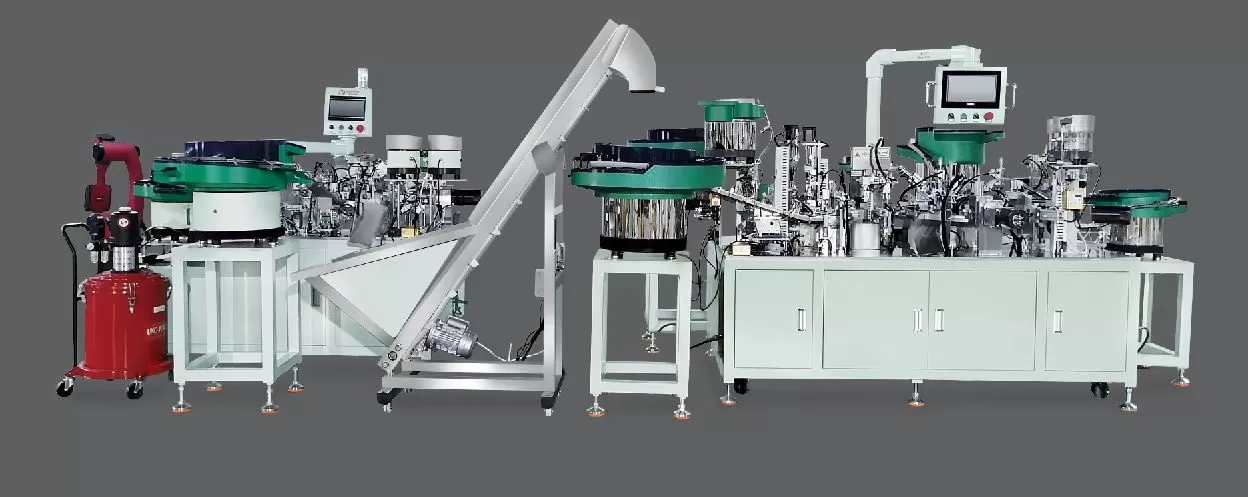
Heat Dissipation Design for Continuous High-Speed Assembly Operations by Sanyhore

2025-12-22

As a leading manufacturer specializing in hinge assembly machines, telescopic drawer slide assembly machines, and roll forming machines, Sanyhore has long focused on optimizing high-speed continuous assembly operations. In such demanding industrial environments, heat generation is an inevitable challenge that directly impacts equipment performance, operational stability, and production efficiency. To address this, Sanyhore has developed sophisticated heat dissipation design strategies tailored to the unique requirements of its assembly systems, ensuring reliable, long-term operation even under continuous high-speed conditions.

Understanding Heat Challenges in High-Speed Assembly Operations

High-speed assembly processes involve rapid mechanical motion, friction between components, and intensive electrical activity—all sources of heat buildup. For example, the motors driving hinge assembly machines or telescopic drawer slide assembly machines often operate at high RPMs, generating significant thermal energy. Similarly, roll forming machines, which shape metal sheets into precise profiles, rely on hydraulic or mechanical presses that produce heat through material deformation. Without effective heat management, this accumulated heat can lead to several critical issues: accelerated component wear, reduced mechanical precision, increased energy consumption, and even unexpected downtime. For Sanyhore, designing robust heat dissipation systems is not merely a technical consideration but a core requirement to maintain the reliability and productivity of its machines.

Key Design Principles for Efficient Heat Dissipation in Sanyhore’s Systems

Sanyhore’s engineering team employs a multi-layered approach to heat dissipation, integrating cutting-edge design principles into each assembly machine. First, material selection is critical. Components like motor housings and frame structures are crafted from high-thermal-conductivity alloys, such as aluminum-bronze or tinned copper, to quickly absorb and transfer heat away from key hotspots. Second, structural optimization plays a vital role. For instance, hinge assembly machines feature integrated heat sinks with enhanced surface area—fin arrays and hollow channels that maximize air flow and heat radiation. Similarly, telescopic drawer slide assembly machines incorporate precision-machined cooling passages within their guide rails, allowing heat to dissipate through conduction to external environments. Additionally, Sanyhore integrates active cooling systems, such as low-noise axial fans and thermoelectric coolers, in high-heat-density areas, ensuring real-time temperature regulation.

Tailored Solutions for Diverse Assembly Needs

Recognizing that different assembly machines have distinct heat profiles, Sanyhore tailors its heat dissipation designs to specific machine types. For hinge assembly machines, which handle small, intricate components, the focus is on compact, localized cooling. These machines often include miniaturized heat pipes and micro-fin systems to target heat generated by the hinge joint mechanisms without adding unnecessary bulk. In contrast, telescopic drawer slide assembly machines, which process longer, heavier components, require a more distributed cooling approach. Here, Sanyhore designs multi-zone cooling modules that align with high-friction slide tracks and drive mechanisms, ensuring consistent thermal control across the entire machine. Roll forming machines, with their high-power press systems, are equipped with forced-air cooling loops that circulate filtered air over hydraulic cylinders and gearboxes, maintaining optimal operating temperatures even during extended production runs.

Verification and Optimization: Ensuring Long-Term Reliability

Sanyhore does not stop at initial design; it rigorously tests each heat dissipation system under real-world conditions. Before releasing hinge assembly machines, telescopic drawer slide assembly machines, or roll forming machines, the engineering team conducts thermal imaging scans, temperature logging, and accelerated aging tests. These tests validate that the designed heat management systems can maintain component temperatures within safe operating ranges (typically below 60°C for critical electronics and 80°C for mechanical parts) even at maximum production speeds. Post-deployment, Sanyhore offers ongoing support, including remote temperature monitoring and software updates, to further refine cooling efficiency based on customer feedback and evolving production demands.

For manufacturers relying on high-speed continuous assembly operations, effective heat dissipation is the foundation of productivity and cost-effectiveness. Sanyhore’s expertise in integrating advanced heat management into hinge assembly machines, telescopic drawer slide assembly machines, and roll forming machines ensures that your production lines run smoothly, efficiently, and reliably. If you’re looking to enhance the performance of your assembly systems, contact Sanyhore today at +86 13425506550 or via email at info@sanyhore.com for a tailored consultation.

We use cookie to improve your online experience. By continuing to browse this website, you agree to our use of cookie.

Cookies

Please read our Terms and Conditions and this Policy before accessing or using our Services. If you cannot agree with this Policy or the Terms and Conditions, please do not access or use our Services. If you are located in a jurisdiction outside the European Economic Area, by using our Services, you accept the Terms and Conditions and accept our privacy practices described in this Policy.
We may modify this Policy at any time, without prior notice, and changes may apply to any Personal Information we already hold about you, as well as any new Personal Information collected after the Policy is modified. If we make changes, we will notify you by revising the date at the top of this Policy. We will provide you with advanced notice if we make any material changes to how we collect, use or disclose your Personal Information that impact your rights under this Policy. If you are located in a jurisdiction other than the European Economic Area, the United Kingdom or Switzerland (collectively “European Countries”), your continued access or use of our Services after receiving the notice of changes, constitutes your acknowledgement that you accept the updated Policy. In addition, we may provide you with real time disclosures or additional information about the Personal Information handling practices of specific parts of our Services. Such notices may supplement this Policy or provide you with additional choices about how we process your Personal Information.


Cookies

Cookies are small text files stored on your device when you access most Websites on the internet or open certain emails. Among other things, Cookies allow a Website to recognize your device and remember if you've been to the Website before. Examples of information collected by Cookies include your browser type and the address of the Website from which you arrived at our Website as well as IP address and clickstream behavior (that is the pages you view and the links you click).We use the term cookie to refer to Cookies and technologies that perform a similar function to Cookies (e.g., tags, pixels, web beacons, etc.). Cookies can be read by the originating Website on each subsequent visit and by any other Website that recognizes the cookie. The Website uses Cookies in order to make the Website easier to use, to support a better user experience, including the provision of information and functionality to you, as well as to provide us with information about how the Website is used so that we can make sure it is as up to date, relevant, and error free as we can. Cookies on the Website We use Cookies to personalize your experience when you visit the Site, uniquely identify your computer for security purposes, and enable us and our third-party service providers to serve ads on our behalf across the internet.

We classify Cookies in the following categories:
 ●  Strictly Necessary Cookies
 ●  Performance Cookies
 ●  Functional Cookies
 ●  Targeting Cookies


Cookie List
A cookie is a small piece of data (text file) that a website – when visited by a user – asks your browser to store on your device in order to remember information about you, such as your language preference or login information. Those cookies are set by us and called first-party cookies. We also use third-party cookies – which are cookies from a domain different than the domain of the website you are visiting – for our advertising and marketing efforts. More specifically, we use cookies and other tracking technologies for the following purposes:

Strictly Necessary Cookies
These cookies are necessary for the website to function and cannot be switched off in our systems. They are usually only set in response to actions made by you which amount to a request for services, such as setting your privacy preferences, logging in or filling in forms. You can set your browser to block or alert you about these cookies, but some parts of the site will not then work. These cookies do not store any personally identifiable information.

Functional Cookies
These cookies enable the website to provide enhanced functionality and personalisation. They may be set by us or by third party providers whose services we have added to our pages. If you do not allow these cookies then some or all of these services may not function properly.

Performance Cookies
These cookies allow us to count visits and traffic sources so we can measure and improve the performance of our site. They help us to know which pages are the most and least popular and see how visitors move around the site. All information these cookies collect is aggregated and therefore anonymous. If you do not allow these cookies we will not know when you have visited our site, and will not be able to monitor its performance.

Targeting Cookies
These cookies may be set through our site by our advertising partners. They may be used by those companies to build a profile of your interests and show you relevant adverts on other sites. They do not store directly personal information, but are based on uniquely identifying your browser and internet device. If you do not allow these cookies, you will experience less targeted advertising.

How To Turn Off Cookies
You can choose to restrict or block Cookies through your browser settings at any time. Please note that certain Cookies may be set as soon as you visit the Website, but you can remove them using your browser settings. However, please be aware that restricting or blocking Cookies set on the Website may impact the functionality or performance of the Website or prevent you from using certain services provided through the Website. It will also affect our ability to update the Website to cater for user preferences and improve performance. Cookies within Mobile Applications

We only use Strictly Necessary Cookies on our mobile applications. These Cookies are critical to the functionality of our applications, so if you block or delete these Cookies you may not be able to use the application. These Cookies are not shared with any other application on your mobile device. We never use the Cookies from the mobile application to store personal information about you.

If you have questions or concerns regarding any information in this Privacy Policy, please contact us by email at . You can also contact us via our customer service at our Site.