
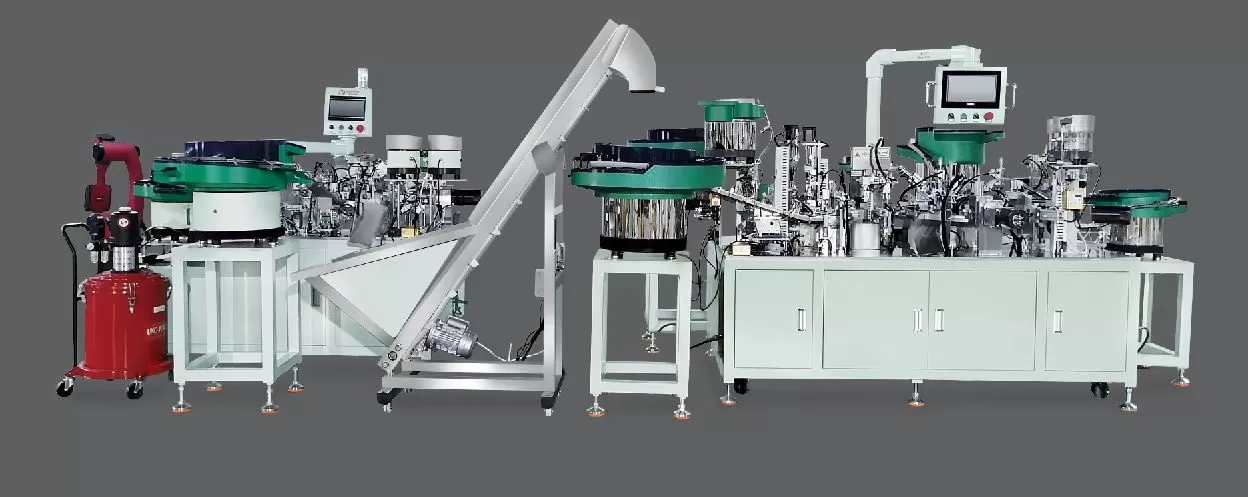
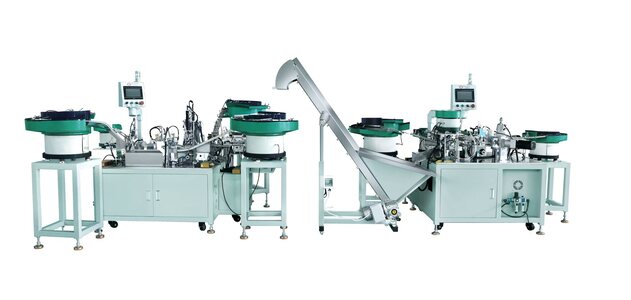
Fault Warning Process for Jieyang Hinge Automatic Assembly Machine

2026-01-13


In the fast-paced landscape of hinge production, reliability and efficiency are critical for maintaining operational success. The Jieyang hinge automatic assembly machine, a key piece of equipment in modern manufacturing, relies on robust fault warning systems to prevent unplanned downtime and ensure consistent output. This guide explores the comprehensive fault warning process for such machines, outlining how they detect, analyze, and resolve issues, while highlighting the expertise of Sanyhore—your trusted partner in hinge assembly machine innovation.

Understanding the Core of Fault Warning Systems in Hinge Assembly Machines

A hinge automatic assembly machine’s fault warning process is underpinned by a sophisticated integration of hardware and software. At its core lies a network of sensors strategically placed throughout the machine, including vibration sensors, temperature transmitters, pressure transducers, and vision inspection systems. These sensors continuously monitor critical operational parameters: for instance, vibration levels detect misalignment in moving components, while temperature sensors flag overheating in motors or hydraulic systems. The collected data is processed in real time by a centralized control unit, which compares it against predefined thresholds and operational benchmarks. When a deviation exceeds these limits, the system initiates a warning sequence, ensuring timely intervention before minor issues escalate into major failures.

Key Warning Signals: How the Machine Communicates Issues

Effective fault warning systems translate complex operational data into clear, actionable signals. Common warning indicators include visual alerts on the machine’s HMI (Human-Machine Interface), such as color-coded lights (yellow for caution, red for critical) and text prompts detailing the issue. Audible signals, like beeps or chimes, complement visual cues to ensure operators are aware even in noisy environments. Additionally, modern systems often send notifications via mobile apps or email, allowing remote monitoring and proactive response. For example, an unexpected increase in product defect rates might trigger a vision system alert, while abnormal noise from the gearbox could activate a vibration sensor warning. These signals are designed to be intuitive, guiding operators to identify the root cause quickly.

Step-by-Step Fault Warning Process: From Detection to Resolution

The fault warning process follows a structured sequence to minimize downtime and ensure thorough resolution. First, detection: sensors capture anomalies, and the control unit analyzes the data to confirm if the deviation is genuine (e.g., distinguishing between a temporary blip and a persistent fault). If confirmed, the system classifies the warning as either Level A (immediate shutdown required) or Level B (operational with caution). For Level A warnings, the machine halts automatically, and the HMI displays a detailed error code, such as “E003: Overheating in Bearing Unit.” Operators then follow the resolution protocol: referencing the machine’s manual, using diagnostic tools to isolate the faulty component, and replacing or repairing it as needed. For Level B warnings, operators address the issue during the next maintenance window, with the control unit logging the event for future analysis. Post-resolution, the system resets, and the machine resumes operation.

Proactive Maintenance: Integrating Warning Data for Long-Term Reliability

Beyond reactive resolution, the fault warning process plays a vital role in proactive maintenance. By analyzing historical warning data, manufacturers can identify recurring issues, predict potential failures, and optimize maintenance schedules. For instance, if the system frequently warns of low lubrication in the guide rails, it may indicate a need for adjusted lubrication intervals or a design flaw in the lubrication system. Sanyhore, as a leader in hinge assembly machine production, incorporates advanced data analytics into its machines, allowing users to access detailed reports on warning trends. This data-driven approach transforms the machine from a passive tool into an active partner in operational efficiency, reducing the risk of unexpected breakdowns and extending the machine’s service life.

Why Sanyhore Hinge Assembly Machines Stand Out in Fault Warning

Sanyhore’s hinge automatic assembly machines are engineered with a focus on reliability and user-friendliness, making their fault warning systems a standout feature. Equipped with high-precision sensors and adaptive control algorithms, our machines accurately detect even subtle deviations, ensuring minimal false alarms and reliable alerts. The intuitive HMI design simplifies error interpretation, while seamless integration with digital tools (e.g., remote monitoring via mobile apps) enhances responsiveness. As a professional manufacturer of hinge assembly machines, telescopic drawer slide assembly machines, and roll forming machines, Sanyhore combines technical expertise with a customer-centric approach, offering tailored support to ensure optimal machine performance.

Contact Sanyhore: Your Partner in Hinge Assembly Machine Optimization

For manufacturers seeking to enhance the reliability of their hinge automatic assembly machines, Sanyhore is the ideal choice. Our commitment to innovation and quality ensures that every machine is built to deliver consistent results, with robust fault warning systems that keep production on track. If you’re experiencing issues with your current equipment or looking to upgrade, reach out to our team today. Call +86 13425506550 or email info@sanyhore.com to discuss how we can support your hinge production needs. Trust Sanyhore to keep your assembly line efficient, reliable, and profitable.

We use cookie to improve your online experience. By continuing to browse this website, you agree to our use of cookie.

Cookies

Please read our Terms and Conditions and this Policy before accessing or using our Services. If you cannot agree with this Policy or the Terms and Conditions, please do not access or use our Services. If you are located in a jurisdiction outside the European Economic Area, by using our Services, you accept the Terms and Conditions and accept our privacy practices described in this Policy.
We may modify this Policy at any time, without prior notice, and changes may apply to any Personal Information we already hold about you, as well as any new Personal Information collected after the Policy is modified. If we make changes, we will notify you by revising the date at the top of this Policy. We will provide you with advanced notice if we make any material changes to how we collect, use or disclose your Personal Information that impact your rights under this Policy. If you are located in a jurisdiction other than the European Economic Area, the United Kingdom or Switzerland (collectively “European Countries”), your continued access or use of our Services after receiving the notice of changes, constitutes your acknowledgement that you accept the updated Policy. In addition, we may provide you with real time disclosures or additional information about the Personal Information handling practices of specific parts of our Services. Such notices may supplement this Policy or provide you with additional choices about how we process your Personal Information.


Cookies

Cookies are small text files stored on your device when you access most Websites on the internet or open certain emails. Among other things, Cookies allow a Website to recognize your device and remember if you've been to the Website before. Examples of information collected by Cookies include your browser type and the address of the Website from which you arrived at our Website as well as IP address and clickstream behavior (that is the pages you view and the links you click).We use the term cookie to refer to Cookies and technologies that perform a similar function to Cookies (e.g., tags, pixels, web beacons, etc.). Cookies can be read by the originating Website on each subsequent visit and by any other Website that recognizes the cookie. The Website uses Cookies in order to make the Website easier to use, to support a better user experience, including the provision of information and functionality to you, as well as to provide us with information about how the Website is used so that we can make sure it is as up to date, relevant, and error free as we can. Cookies on the Website We use Cookies to personalize your experience when you visit the Site, uniquely identify your computer for security purposes, and enable us and our third-party service providers to serve ads on our behalf across the internet.

We classify Cookies in the following categories:
 ●  Strictly Necessary Cookies
 ●  Performance Cookies
 ●  Functional Cookies
 ●  Targeting Cookies


Cookie List
A cookie is a small piece of data (text file) that a website – when visited by a user – asks your browser to store on your device in order to remember information about you, such as your language preference or login information. Those cookies are set by us and called first-party cookies. We also use third-party cookies – which are cookies from a domain different than the domain of the website you are visiting – for our advertising and marketing efforts. More specifically, we use cookies and other tracking technologies for the following purposes:

Strictly Necessary Cookies
These cookies are necessary for the website to function and cannot be switched off in our systems. They are usually only set in response to actions made by you which amount to a request for services, such as setting your privacy preferences, logging in or filling in forms. You can set your browser to block or alert you about these cookies, but some parts of the site will not then work. These cookies do not store any personally identifiable information.

Functional Cookies
These cookies enable the website to provide enhanced functionality and personalisation. They may be set by us or by third party providers whose services we have added to our pages. If you do not allow these cookies then some or all of these services may not function properly.

Performance Cookies
These cookies allow us to count visits and traffic sources so we can measure and improve the performance of our site. They help us to know which pages are the most and least popular and see how visitors move around the site. All information these cookies collect is aggregated and therefore anonymous. If you do not allow these cookies we will not know when you have visited our site, and will not be able to monitor its performance.

Targeting Cookies
These cookies may be set through our site by our advertising partners. They may be used by those companies to build a profile of your interests and show you relevant adverts on other sites. They do not store directly personal information, but are based on uniquely identifying your browser and internet device. If you do not allow these cookies, you will experience less targeted advertising.

How To Turn Off Cookies
You can choose to restrict or block Cookies through your browser settings at any time. Please note that certain Cookies may be set as soon as you visit the Website, but you can remove them using your browser settings. However, please be aware that restricting or blocking Cookies set on the Website may impact the functionality or performance of the Website or prevent you from using certain services provided through the Website. It will also affect our ability to update the Website to cater for user preferences and improve performance. Cookies within Mobile Applications

We only use Strictly Necessary Cookies on our mobile applications. These Cookies are critical to the functionality of our applications, so if you block or delete these Cookies you may not be able to use the application. These Cookies are not shared with any other application on your mobile device. We never use the Cookies from the mobile application to store personal information about you.

If you have questions or concerns regarding any information in this Privacy Policy, please contact us by email at . You can also contact us via our customer service at our Site.