

The Jieyang Hinge Automatic Assembly Machine represents a significant advancement in hinge manufacturing, integrating precision engineering and automated control to enhance production efficiency and product consistency. As a core component in the hinge production line, its technical process involves multiple stages of mechanical, electrical, and software collaboration, ensuring each hinge meets strict quality standards. Below is an in-depth analysis of its detailed technical process.
Design and R&D Foundation: Before physical production, the design and R&D team conducts thorough market research and customer需求 analysis to define key parameters, including hinge size, material, assembly accuracy, and production capacity. Using 3D modeling software (e.g., SolidWorks), the machine’s structure is simulated and optimized for stability and durability. Finite element analysis (FEA) is performed on critical components like the frame and positioning fixtures to ensure they can withstand long-term high-speed operation. Prototype testing is then carried out to validate the design, with adjustments made based on performance data such as load capacity and motion smoothness.
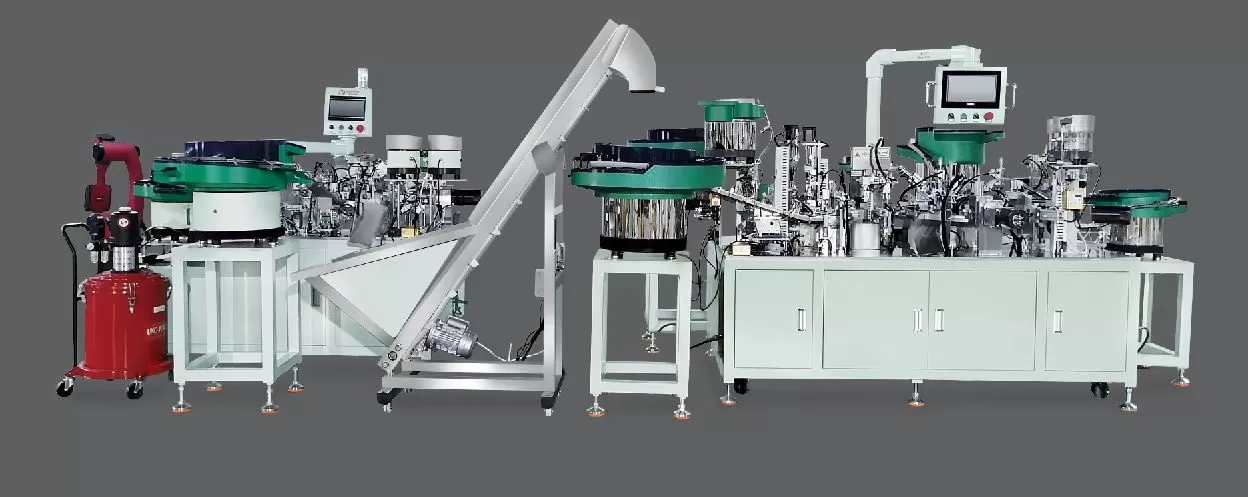
Mechanical Structure Composition: The machine’s mechanical system consists of several functional modules. The feeding system, equipped with vibration bowls and linear feeders, sorts and aligns raw hinge components (e.g., leaves, pins, springs) to ensure consistent orientation. The positioning mechanism uses precision guide rails and clamping cylinders to fix the hinge parts at predefined coordinates, minimizing assembly errors. The assembly unit integrates servo-driven press arms and ultrasonic welding modules, which press-fit pins into the hinge leaves or perform welding for secure connections. A transfer mechanism, typically using a synchronous belt or cam divider, moves the assembled hinges between workstations with sub-millimeter accuracy. The discharge system then collects the finished products into a conveyor belt for subsequent packaging.
Electrical Control System: The electrical control system serves as the "brain" of the machine, coordinating all components. A high-performance PLC (Programmable Logic Controller) acts as the main controller, receiving signals from sensors and executing predefined assembly logic. Sensors, including photoelectric sensors for component detection, displacement sensors for position feedback, and force sensors for assembly force monitoring, ensure real-time data collection. The human-machine interface (HMI), a touchscreen display, allows operators to set parameters (e.g., assembly speed, pressure, and tolerance) and monitor production metrics like yield rate and machine status. The control system also includes a safety interlock module, which triggers an emergency stop if any component malfunctions, protecting equipment and operators.
Core Working Principle: The assembly process follows a cyclic workflow. First, raw components are fed into the machine via the feeding system and positioned by the clamping fixtures. The PLC then coordinates the transfer mechanism to move the hinge leaves to the assembly station. The press arm descends, using a pre-set force to insert the pin into the aligned holes of the leaves, while the ultrasonic module may activate to strengthen the joint. After assembly, the force sensor verifies the connection strength; if it falls below the standard threshold, the machine rejects the defective product. The transfer mechanism then moves the qualified hinges to the discharge system, completing one assembly cycle. This cycle repeats at a high speed, typically 20-30 hinges per minute, depending on hinge complexity.
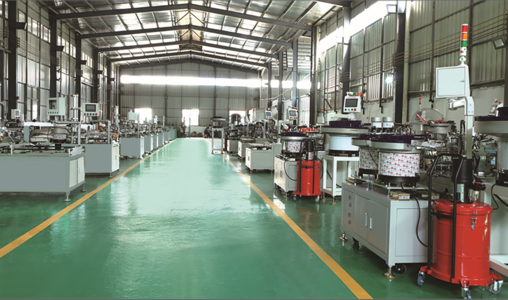
Automation Integration and Debugging: Post-design, the machine undergoes integration and on-site debugging. Engineers connect the mechanical, electrical, and software systems, ensuring seamless communication between modules. During commissioning, the machine is tested with actual production materials to verify assembly accuracy, motion synchronization, and error handling. Parameters such as servo motor speed, press pressure, and sensor sensitivity are fine-tuned to optimize production efficiency and reduce waste. For example, adjusting the clamping cylinder pressure can prevent component damage, while optimizing the transfer timing ensures no jams occur in the workflow. The debugging phase also includes operator training, where staff learn to operate the HMI, perform routine maintenance, and troubleshoot common issues.
Quality Control and Optimization: Throughout production, the machine incorporates multi-layer quality control measures. The in-line inspection system uses vision cameras to check for visual defects (e.g., scratches, misaligned parts) and measure dimensional accuracy via image processing algorithms. The force and torque testing stations verify the assembly strength, ensuring hinges meet load-bearing requirements. After batch production, a sampling test is conducted to analyze long-term stability, with adjustments made to the control program or mechanical parameters if deviations are found. Continuous optimization, based on production feedback and technological advancements, ensures the machine remains efficient and adaptable to new hinge designs.
As a professional manufacturer of hinge assembly machines, Sanyhore (sanyhore.com) specializes in developing and producing high-quality automatic assembly equipment, including hinge assembly machines, telescopic drawer slide assembly machines, and roll forming machines. With years of experience in the field, our machines combine precision, reliability, and cost-effectiveness, meeting the needs of hinge manufacturers for efficient and stable production. For inquiries about the Jieyang Hinge Automatic Assembly Machine or our other products, please contact our sales team at +86 13425506550 or email info@sanyhore.com. We look forward to partnering with you to enhance your production capabilities.


